.png)
How We Helped League Twenty Two Scale From Reactive Hiring to Strategic Talent Readiness

Updated: Jan 18
TDJ built a custom Airtable solution to help the ops team track roles, assignments, and project staffing across big brand clients. Timeline: January 15 – April 15
To keep our clients' info safe, we don't share a full demo. Instead, this case study walks you through the different stages of our project and includes feedback from the team.

Client Overview
League Twenty Two is a creative experiential marketing agency known for producing culturally-centered campaigns and activations for brands like Nike, Essence, and CultureCon. With 7–8 full-time W2 employees and 10–15 contractors, they were growing fast and needed more structure in place to manage their operations effectively.
Kenley, the Senior Operations Manager, followed The Digital Jane and reached out after her recent promotion. She was looking for support in refining their internal systems, especially talent management.
The Challenge
League Twenty Two was at an inflection point. With high-profile clients like Nike and Essence, demand was growing, but their operations couldn't keep pace.
Every new project required scrambling to screen and onboard 10-15 contractors. The ops team was spending 2-3 hours per freelancer, pulling information from spreadsheets, email threads, and memory. Critical details were falling through the cracks.
The bottleneck wasn't talent availability. It was infrastructure. Without a scalable way to manage their freelance pipeline, the team couldn't confidently take on new work.
As Kenley (Senior Operations Manager) put it: "We were missing very integral things that could have potentially allowed us not to pick them."
Phase One: Diagnose the Root Cause
Timeline: 4–6 Weeks
Focus: Discovery, Team Clarity, and Operational Readiness
Before we touched any tools, we needed to understand how the team works. We conducted workflow discovery sessions with each team member, mapping their day-to-day work and identifying where confusion, duplication, and gaps existed.
What we found:
Role ownership between the ops manager and coordinator wasn't clearly defined
13 core processes existed but weren't documented; they lived in people's heads
The Airtable base they'd started building wasn't being used because it didn't match their actual workflows
The insight: This wasn't a tool problem. It was a clarity problem. Without defined ownership and documented processes, no system would stick.
Impact:
Realigned job descriptions to reflect actual work
Gave the coordinator confidence to take ownership: "I feel pretty secure in my role now... I'm understanding how I can take more ownership and take things off of Kenley's plate."
Created a roadmap for what needed to be built and why
Phase Two: Implementation & Documentation
Timeline: 10–12 Weeks
Focus: System Setup, Process Development, and SOPs

With clarity in place, we built the operational backbone they needed to manage talent at scale.
We designed two custom Airtable bases:
Ops/Admin Matrix: Centralized expense tracking and task management
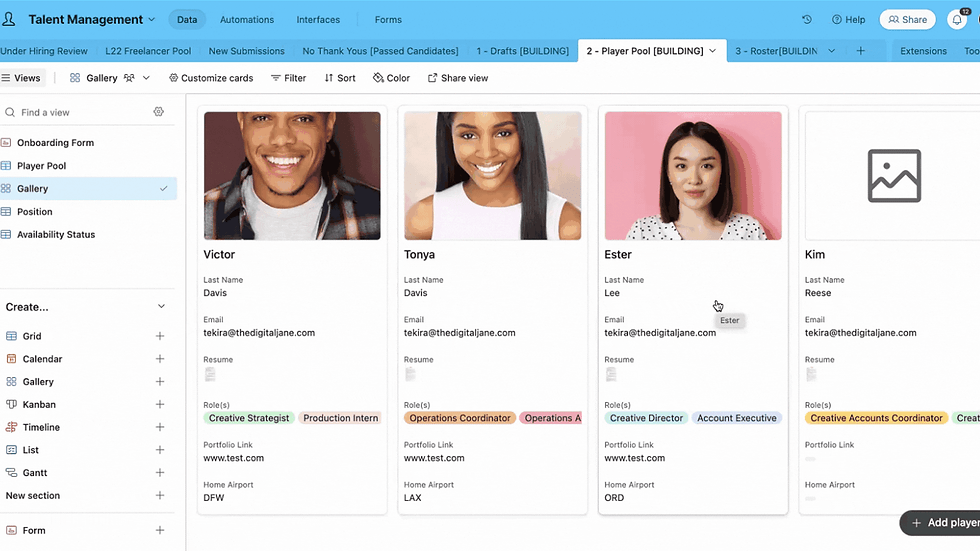
Talent Management Base: A fully automated system for screening, onboarding, and assigning freelancers
But the bases were just the vehicle. The real value was in the infrastructure design:
Automated workflows replaced manual handoffs
Filters and views surfaced the right talent at the right time
Calendar integrations gave leadership visibility into project staffing
Every workflow was documented with SOPs and training videos so the team could own and evolve the systems independently.
Impact:
"You just condensed like four hours of Audrey's work into like 10 minutes." (Kenley)
Freelancer screening went from chaotic to systematic
The team could now manage 10-15 contractors per project without bottlenecks.
Phase Three: Training & Handoff
Timeline: 4 Weeks
Focus: Training, Handoff, and Support
The final phase wasn't about handoff. It was about building internal capacity.
We trained the ops team to not just use the systems, but to own them. They walked leadership through the new workflows with confidence and clarity.
Impact:
Leadership recognized the transformation: "This is real good. Y'all taught her very well." (Nigel)
The ops team went from reactive to proactive: "When projects come, we have an army of folks ready to go." (Kenley)
The agency could now scale confidently
The Transformation
Before:
Ops team spent 2-3 hours onboarding each contractor
Hiring was reactive, scrambling to find talent when projects came in
Leadership couldn't confidently take on new work without worrying about bottlenecks
Critical information lived in spreadsheets, email, and people's heads
After:
Freelancer onboarding takes 10 minutes
Talent pipeline is proactive with vetted contractors ready before projects arrive
Leadership can scale client work without scaling operational burden
All processes are documented, centralized, and sustainable
The real impact: League Twenty Two now has the operational infrastructure to support their growth ambitions. They're no longer limited by internal capacity. They're ready to scale.
By the Numbers
14 custom boards delivered
7 documented processes
4 SOPs for core workflows
2 system audits and rebuilds
What This Taught Us
Operations isn't about tools. It's about clarity, ownership, and readiness.
The best systems don't just save time. They unlock capacity. When teams know who owns what, have documented processes, and can surface information when they need it, they move from firefighting to strategic execution. That's the difference between operational support and operational leadership.
“Thank you so much. We really appreciate this process, and we know that it’s going to be extremely helpful for streamlining all of our incoming talent. It’s nice to have this consistent flow happening in the background, so when projects come, we have an army of folks ready to go.” — Kenley
Interested in transforming how your team works?
Learn more about Foundation First or book a discovery call.


Comments